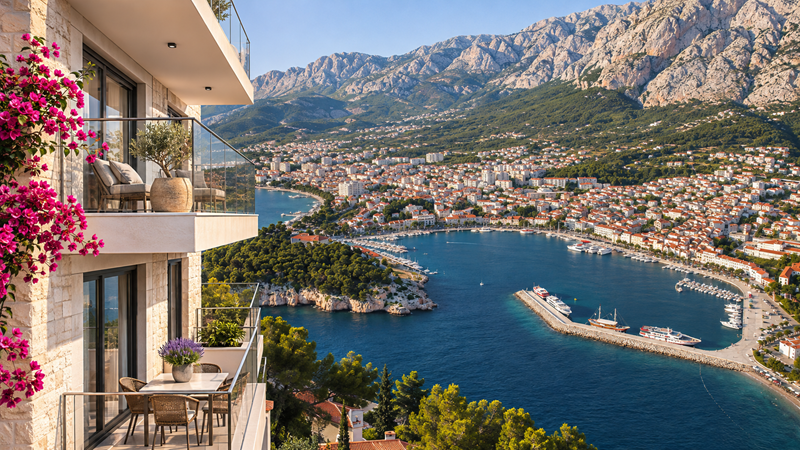
Property tax (porez na nekretnine) is an annual local tax paid by the owner of a residential property that is not used as a permanent residence, at a rate of 0.60 to 8.00 euros per square metre of usable floor area. It was introduced on 1 January 2025 to replace the holiday home tax and should not be confused with the real estate transfer tax, which the buyer pays only once, when buying. If you are buying an apartment or holiday flat on the Makarska Riviera that you will not use as your permanent residence, factor this cost into every year you own the property.
What is property tax in Croatia?
Property tax is a tax paid every year on residential property, based on its usable floor area. It is governed by the Local Taxes Act (Zakon o lokalnim porezima), and since 2025 every town and municipality in Croatia has been required to introduce it. The revenue stays in the local community: 80% goes to the town or municipality and 20% to the county.
The new tax replaced the holiday home tax, and the difference is more than a change of name. The upper limit was raised from 5.00 to 8.00 euros per m², and according to the Croatian Tax Administration the tax is no longer optional for towns but mandatory.
Which properties are taxed and which are not?
The tax applies to residential buildings, apartments, residential parts of mixed-use buildings and other self-contained spaces intended for living. This includes apartments and houses used only occasionally, for holidays or for tourist rentals.
Farm buildings used to store agricultural machinery and tools, and properties for which the utility fee is paid as for business premises, are not subject to the tax.
Who pays property tax?
Property tax is paid by whoever owns the property on 31 March of the year for which the tax is assessed. The taxpayer can be a Croatian or foreign individual or company, so owners living abroad pay the tax in the same way. If the owner cannot be identified, the tax is paid by the user of the property.
The 31 March date matters when you buy. The tax authority issues its decision based on the condition, use and ownership of the property on that day, and changes during the year only apply from the following year. If you buy an apartment in May, for example, the tax for that year is assessed to the previous owner, and you become the taxpayer from the next year.
How much is property tax?
Property tax is 0.60 to 8.00 euros per m² of usable floor area per year. The exact amount is set by the town or municipality where the property is located, and it can differ between settlements, streets or zones. It can also be increased for the age of the property or features that add to its value, but never above 8.00 euros per m². If the town or municipality has not adopted a decision, the minimum of 0.60 euros per m² applies.
For 2026, the amount was increased in 41 towns and municipalities, reduced in 12 and left unchanged in 503. According to the Croatian Tax Administration, 84 towns and municipalities set the tax at between 5.00 and 8.00 euros per m².
The tax decision is issued by the Tax Administration or by the town itself if it has taken over assessment and collection. The tax must be paid within 15 days of receiving the decision.
How do you calculate property tax?
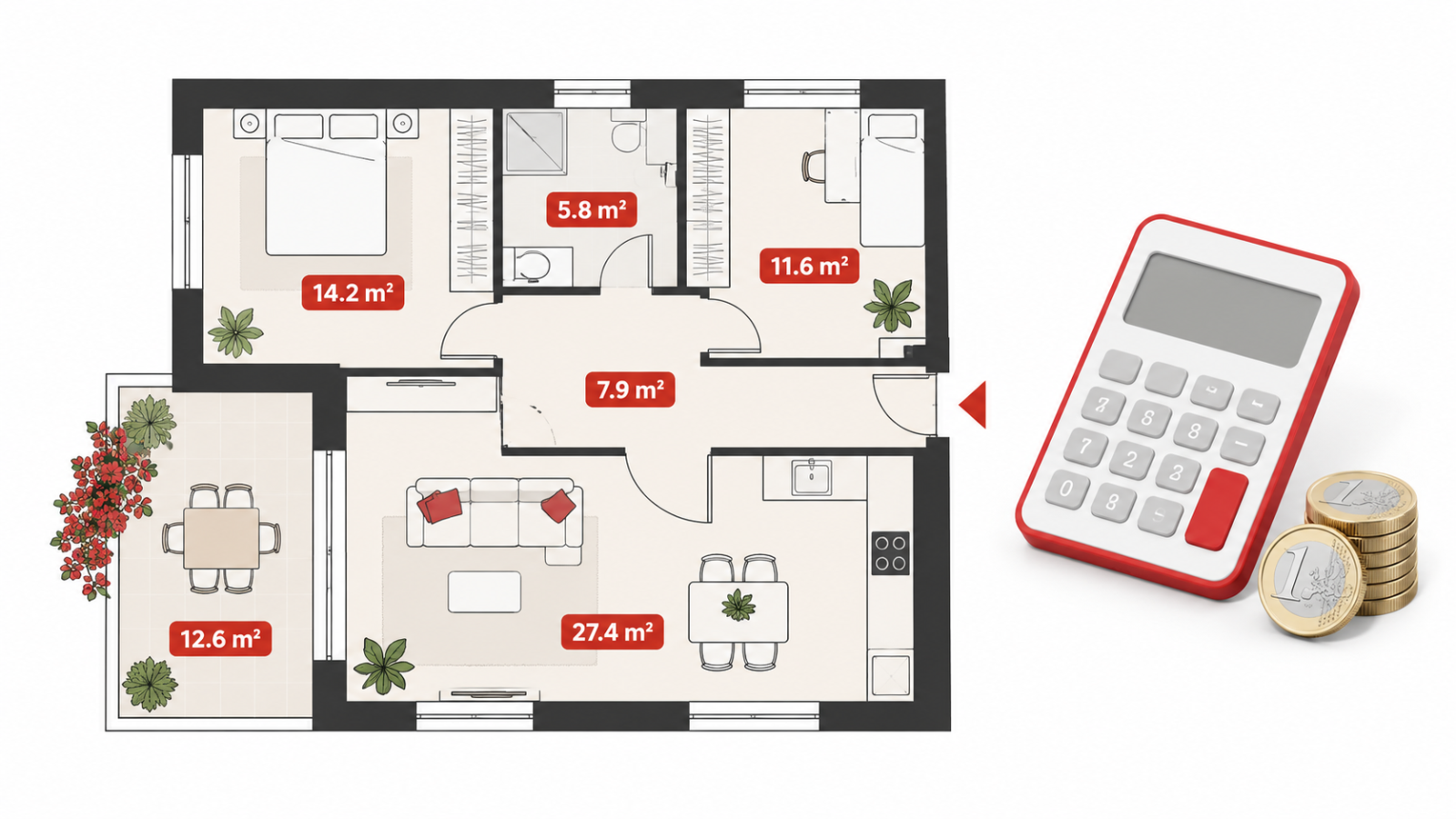
The calculation is simple: the usable floor area of the property multiplied by the amount set by the town or municipality.
|
Example
|
Floor area
|
Rate per m²
|
Annual tax
|
|
Holiday apartment in Makarska
|
45 m²
|
EUR 8.00
|
EUR 360
|
|
Apartment in Makarska
|
60 m²
|
EUR 8.00
|
EUR 480
|
|
Holiday house in Makarska
|
120 m²
|
EUR 8.00
|
EUR 960
|
|
Apartment in a municipality with no decision
|
60 m²
|
EUR 0.60
|
EUR 36
|
When buying, compare the same apartment in two locations: the difference in annual tax can amount to several hundred euros, depending on the local decision.
How much is property tax in different towns?
Check the amount for each town or municipality in its current decision on local taxes. Towns and municipalities can change the decision for the following year no later than 15 December of the current year, and the change takes effect on 1 January. If the decision is not changed, the same amount continues to apply. These are the amounts for the Makarska Riviera and Split:
|
Town / municipality
|
2025 (EUR/m²)
|
2026 onwards (EUR/m²)
|
Source
|
|
Makarska
|
5.00
|
8.00
|
Decision on Town Taxes, Official Gazette of the Town of Makarska 18/2025
|
|
Baška Voda
|
8.00
|
3.00
|
Tax Administration, 2025/2026 comparison
|
|
Brela
|
5.00
|
3.00 to 5.00 (by zone)
|
Tax Administration, 2025/2026 comparison
|
|
Tučepi
|
5.00
|
5.00
|
Tax Administration, 2025/2026 comparison
|
|
Podgora
|
5.00
|
5.00
|
Tax Administration, 2025/2026 comparison
|
|
Gradac
|
5.00
|
5.00
|
Tax Administration, 2025/2026 comparison
|
|
Split
|
1.99
|
5.00
|
Tax Administration, 2025/2026 comparison
|
The Town of Makarska raised the tax to the legal maximum. The Decision on Town Taxes was adopted on 25 November 2025 and has applied since 1 January 2026, and property tax in Makarska is assessed and collected by the town administration, not the Tax Administration. Split raised the rate from 1.99 to 5.00 euros per m², while Baška Voda cut it from 8.00 to 3.00 euros per m² for 2026. The amounts in the table reflect the decisions in force in November 2026. The same amounts apply in 2027 unless a town or municipality adopts a change by 15 December 2026, so check the current decision before you buy.
Who does not pay property tax?
Property tax is not paid on property used as a permanent residence. Article 27 of the Local Taxes Act also provides for other exemptions:
-
property let for permanent residence under a lease agreement, if it is let for at least 10 months of the year
-
property that a host, as defined by the hospitality regulations, uses as their permanent residence
-
property that is unfit for living due to a declared natural disaster
-
property whose residential use is not possible (the owner must prove this)
-
public-purpose and institutional accommodation property, and property owned by a town or municipality within its own area
-
property held for sale in a company's books or taken over for unpaid claims, if fewer than six months have passed by 31 March
A town or municipality can also exempt socially vulnerable residents by decision. Registering a residence address alone does not prove permanent residence: the law states expressly that a registered address is not sufficient on its own, so the tax authority may ask for other evidence.
The only lawful way to avoid property tax is to meet one of the conditions for exemption, for example by living in the property permanently or letting it on a long-term lease, and to report this on time.
What must be reported by 31 March?
By 31 March you only report information the tax authority does not already have: a change in the assessed floor area or use of the property, and evidence for an exemption. Reports are submitted to the competent Tax Administration office or to the town or municipality if it assesses the tax itself. If you bought the property last year and will use it as your permanent residence, send the evidence before that deadline.
How do you appeal a property tax decision?
If the decision is wrong, you can lodge a legal remedy within the deadline and in the manner stated in the instructions on the decision itself. The most common reasons are a property you live in permanently, a property you have sold, or an incorrect floor area or use.
-
1. Check the legal remedy instructions on the decision: they state the deadline and the authority to contact.
-
2. State what is wrong in the decision (exemption, floor area, ownership on 31 March).
-
3. Attach evidence: lease agreement, sale contract, proof of permanent residence, floor area records.
An appeal does not postpone payment, so the 15-day deadline keeps running while the appeal is being decided. In March 2026, the Tax Administration announced that objections to property tax decisions would be resolved within two months, that no interest or enforced collection would apply until they were checked, and that tax already paid under a cancelled decision would be refunded automatically.
How is property tax different from real estate transfer tax?
Property tax is paid every year for as long as you own the property, while real estate transfer tax is paid once, when you acquire it. The first depends on floor area and the local decision, the second on the market value of the property.
| |
Property tax
|
Real estate transfer tax
|
|
When it is paid
|
Every year
|
Once, on acquisition
|
|
Who pays
|
Owner on 31 March
|
Buyer or other acquirer
|
|
Tax base
|
Usable floor area (m²)
|
Market value of the property
|
|
Amount
|
EUR 0.60 to 8.00 per m²
|
3%
|
|
Who sets the amount
|
Town or municipality
|
The law, the same across Croatia
|
|
Payment deadline
|
15 days from receipt of the decision
|
15 days from receipt of the decision
|
|
New build with VAT
|
Paid
|
Not paid (VAT is paid instead)
|
Real estate transfer tax is 3% of the market value, and it is paid by the buyer. If you buy from a developer who charges VAT, no transfer tax is payable. There has been no general transfer tax exemption for first-time buyers since 1 January 2019. Young buyers can still get a refund: Croatian citizens under 45 who buy their first residential property are entitled to a refund of the real estate transfer tax paid, or 50% of the VAT on a new build. The contract must have been signed after 1 January 2025, the buyer must have their registered residence at the property and live there, and the tax must have been paid in full. The application is submitted to the Agency for Legal Transactions and Real Estate Brokerage (APN) within 24 months of signing the contract, and limits on floor area and price per m² also apply.
For more on when the obligation arises, how it is reported and who is exempt, read our guide Real estate transfer tax.
What other costs does a property owner have?
In addition to property tax, owners also pay an annual utility fee (komunalna naknada). These are two separate obligations, so an exemption from property tax does not mean an exemption from the utility fee. If you let an apartment to tourists, you also pay income tax on the rental, and this has no effect on your property tax obligation. For an overview of all the costs of buying, see Costs of buying an apartment in Croatia.
Frequently asked questions about property tax
Is property tax paid on an apartment let to tourists?
Yes. Tourist letting is not a ground for exemption from property tax. The Local Taxes Act states expressly that paying income tax on rental income does not affect the property tax obligation. The exception is a property in which the host lives permanently. To find out what else you need for legal tourist letting, read Apartment categorization.
Do foreigners pay property tax in Croatia?
Yes. Property tax is paid by Croatian and foreign individuals and companies that own the property on 31 March. A foreign owner of a house or apartment on the coast pays the tax according to the decision of the town or municipality where the property is located.
Is property tax paid on a second home?
Property tax is paid on every residential property that is not used as a permanent residence and does not meet another condition for exemption. A second home, such as a holiday apartment by the sea, is as a rule taxable.
Who pays property tax if the apartment was bought during the year?
The tax for the current year is paid by whoever owned the property on 31 March. A buyer who purchased the property after that date becomes liable for property tax from the following year.
When is property tax due?
Property tax must be paid within 15 days of receiving the tax decision. An appeal against the decision does not postpone payment.
What if the town has not adopted a property tax decision?
If the town or municipality has not adopted a decision, property tax is 0.60 euros per m² of usable floor area, which is the legal minimum.
Check the annual costs before you buy
Property tax on the Makarska Riviera is no longer a negligible cost: since 2026, Makarska has charged the legal maximum of 8.00 euros per m², and this amount applies until the town changes its decision. When buying a holiday apartment or home, budget for both the one-off 3% transfer tax and the annual property tax, and check the amount for the specific location in the local decision. This article is for information only and is not tax advice.
Browse the current AB Adrion property listings in Makarska and the surrounding area or contact the agency for advice before you buy.